
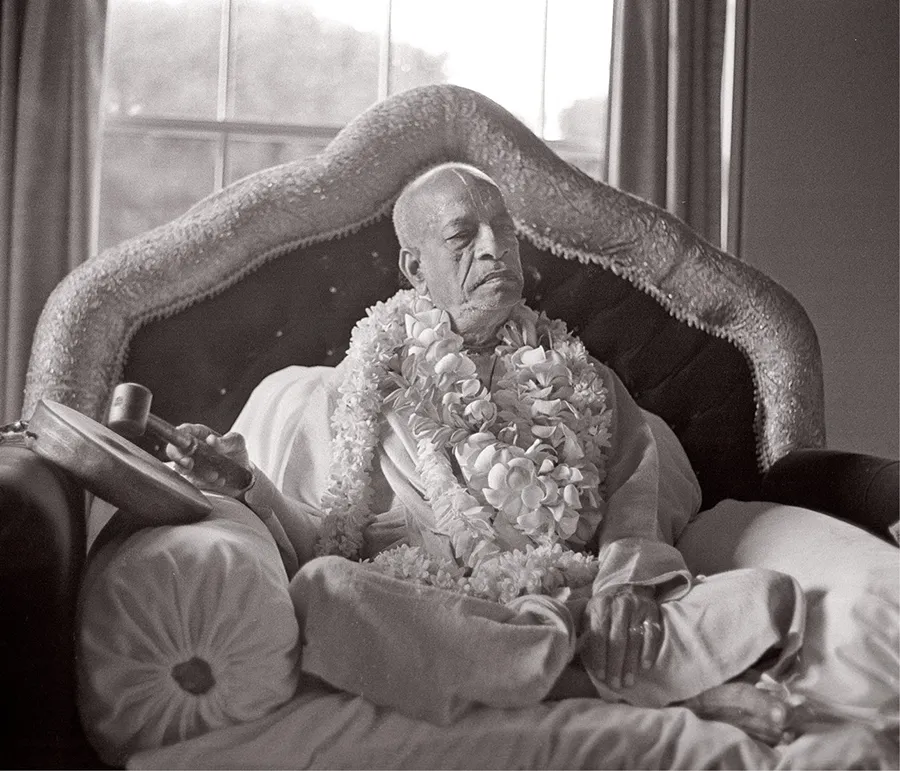
Yasya prasādād bhagavat-prasādo: “By the mercy of the spiritual master one receives the benediction of Kṛṣṇa.” By celebrating Śrīla Prabhupāda’s Vyāsa-pūjā we are remembering, glorifying, and expressing our gratitude to Śrīla Prabhupāda, and by glorifying him, we reaffirm our faith in him, reaffirm our guru-niṣṭhā.
This movement was started on faith. When Śrīla Prabhupāda first landed in the USA, he had faith that the people of America would understand Kṛṣṇa consciousness by hearing the knowledge of the Bhāgavatam. When he first got off the boat, he didn’t know whether to turn right or left. But he had firm faith in the holy name and his guru, nāma-niṣṭhā and guru-niṣṭhā. By experiencing his words and actions and following his instructions, we were also imbued with that faith.
Once, when His Holiness Tamal Krishna Goswami had an operation and was under anesthesia, he had a vision of Śrīla Prabhupāda reporting to the previous ācāryas. Śrīla Prabhupāda was explaining that his disciples did not have much qualification of austerity, purity, or learning, but they had one good quality – they had guru-niṣṭhā, firm faith in him.
One time, when Śrīla Prabhupāda was celebrating the Vyāsa-pūjā of his own guru, Śrīla Bhaktisiddhānta Sarasvatī Mahārāja, he gave the following example. Śrīla Vyāsadeva concluded his first prayer in the Bhāgavatam with the word dhīmahi. In his lecture, Śrīla Prabhupāda also used the word dhīmahi and explained that by using this word, Śrīla Vyāsadeva was including all of his followers in his worship of Lord Kṛṣṇa. Śrīla Prabhupāda said, “And we shall together offer flowers. Actually, the worship is … that is my duty. But sagoṣṭhī. Now I’ll have to offer my respect with my spiritual family members, sagoṣṭhī. That is called sagoṣṭhī. Just like Vyāsadeva says, dhīmahi. He’s offering prayer sagoṣṭhī – with all his followers and disciples. That is the process.”
In our Vrindavan temple we often see an Indian woman come for darshan holding one child on her hip, another by hand, and perhaps still another unborn in her abdomen. When she bows down to offer obeisances, all her children bow down also. Similarly, Śrīla Prabhupāda saw all living entities as part of Kṛṣṇa’s family and desired to bring them all to surrender at Kṛṣṇa’s lotus feet. Śrīla Prabhupāda’s satisfaction was to see everyone happy by chanting Hare Kṛṣṇa, taking prasādam, and reading Kṛṣṇa’s books. He did not discriminate as to who was qualified and who was not. He simply brought us all with him.
Śrīla Prabhupāda is more merciful than Kṛṣṇa. In the Bhagavad-gītā (18.67) Lord Kṛṣṇa says, “This confidential knowledge may never be explained to those who are not austere or devoted or engaged in devotional service, nor to one who is envious of Me.” In his purport to Gītā 18.71 Śrīla Prabhupāda writes, “In the sixty-seventh verse of this chapter, the Lord explicitly forbade the Gītā’s being spoken to those who are envious of the Lord. In other words, the Bhagavad-gītā is for the devotees only. But it so happens that sometimes a devotee of the Lord will hold open class, and in that class not all the students are expected to be devotees. Why do such persons hold open class? It is explained here that although not everyone is a devotee, still there are many men who are not envious of Kṛṣṇa … Thus a pure devotee of the Lord gives everyone a chance to become free from all sinful reactions and to become a devotee of the Lord.”
Where would we have been if Śrīla Prabhupāda had not opened his class to us?
Śrīla Prabhupāda said that “impossible” is a word in a fool’s dictionary. So Śrīla Prabhupāda empowered us to do the impossible. He had us make so many temples full of devotees and empowered us to distribute his books during huge marathons. And amazing Deity worship – who ever thought we would be worshiping Rādhā-Kṛṣṇa Deities in India and all over the world?
How did we get this faith? In his purport to Śrīmad-Bhāgavatam 1.5.23, Śrīla Prabhupāda writes, “Service of the devotee is more valuable than the service of the Lord.” We tried to serve him, but we could not keep up with him in any way, especially on his morning walks. He slept less, traveled more, preached more, and did more austerities than we could. So we just tried to follow him, although we could not keep up with him.
By trying to serve Śrīla Prabhupāda, our faith grew. There was one man in Juhu, Mumbai, who was building rooms for Śrīla Prabhupāda’s disciples on top of the tenants’ buildings behind the temple construction. His name was Mr. Sethi. One day, he came to see Śrīla Prabhupāda covered in cement and dust. Śrīla Prabhupāda said to him, “Just as you are building these rooms for my disciples here, Kṛṣṇa is building rooms for you in Goloka Vrindavan. Mr. Sethi replied, “But Swamijī, I am so sinful! How can I go?” Śrīla Prabhupāda said, “That I will see!”
We are grateful to Śrīla Prabhupāda for giving us this opportunity to serve him. Gratitude doesn’t mean simply saying “thank you.” If we are grateful to Śrīla Prabhupāda, we must reciprocate with him by following his instructions. He wanted all of us to preach and share the knowledge we had been given. Lord Caitanya brought the desire tree of devotional service to this world. “Thus the Lord brought the desire tree of devotional service to this earth and became its gardener. He sowed the seed and sprinkled upon it the water of His will.” (Caitanya-caritāmṛta, Ādi 9.9)
Caitanya-caritāmṛta, Ādi 9.18 states, “Thus the branches of the Caitanya tree formed a cluster or society, with great branches covering all the universe.” From Śrīla Prabhupāda’s purport: “Our International Society for Krishna Consciousness is one of the branches of the Caitanya tree.”
“The fruits ripened and became sweet and nectarean. The gardener, Śrī Caitanya Mahāprabhu, distributed them without asking any price…. Not considering who asked for it and who did not, nor who was fit and who unfit to receive it, Caitanya Mahāprabhu distributed the fruit of devotional service.” (Caitanya-caritāmṛta, Ādi 9.27, 29)
In his purport to Caitanya-caritāmṛta, Ādi 9.29, Śrīla Prabhupāda writes: “The only purpose of the preachers of the saṅkīrtana movement must be to go on preaching without restriction. That is the way in which Śrī Caitanya Mahāprabhu introduced this saṅkīrtana movement to the world.”
“I am the only gardener,” Lord Caitanya states. “How many places can I go? How many fruits can I pick and distribute?” (Caitanya-caritāmṛta, Ādi 9.34)
From Śrīla Prabhupāda’s purport: “This indicates that all classes of devotees should combine to distribute the Hare Kṛṣṇa mahā-mantra without consideration of the time, place, or situation.”
Lord Caitanya continues, “Therefore I order every man within this universe to accept this Kṛṣṇa consciousness movement and distribute it everywhere. “Distribute this Kṛṣṇa consciousness movement all over the world. Let people eat these fruits and ultimately become free from old age and death.” (Caitanya-caritāmṛta, Ādi 9.36, 39)
Caitanya-caritāmṛta, Ādi 7.20–21 states: “The characteristics of Kṛṣṇa are understood to be a storehouse of transcendental love. Although that storehouse of love certainly came with Kṛṣṇa when He was present, it was sealed. But when Śrī Caitanya Mahāprabhu came with His associates of the Pañca-tattva, they broke the seal and plundered the storehouse to taste transcendental love of Kṛṣṇa. The more they tasted it, the more their thirst for it grew.”
When Kṛṣṇa appeared on this planet, He brought with Him the treasure of love of Godhead, but the treasure box was locked. When Lord Caitanya came, He broke open the box and distributed the treasure all over India. But that treasure was still locked up in India. Then Śrīla Prabhupāda came, again broke open the box, and gave the treasure out freely all over the world. He did not discriminate as to who was qualified and who was not. He taught us that we are not these bodies and don’t belong to any varṇa or āśrama.
As Lord Caitanya states:
nāhaṁ vipro na ca nara-patir nāpi vaiśyo na śūdro
nāhaṁ varṇī na ca gṛha-patir no vanastho yatir vā
kintu prodyan-nikhila-paramānanda-pūrnāmṛtābdher
gopī-bhartuḥ pada-kamalayor dāsa-dāsānudāsaḥ
I am not a brāhmaṇa, I am not a kṣatriya, I am not a vaiśya or a śūdra. Nor am I a brahmacārī, a householder, a vānaprastha or a sannyāsī. I identify Myself only as the servant of the servant of the servant of the lotus feet of Lord Śrī Kṛṣṇa, the maintainer of the gopīs. He is like an ocean of nectar, and He is the cause of universal transcendental bliss. He is always existing with brilliance. (Caitanya-caritāmṛta, Madhya 13.80)
We are all servants of the servant of the gopīs eternally. We do not belong to any caste or material designation. For a preacher there is only one qualification:
kibā vipra, kibā nyāsī, śūdra kene naya
yei kṛṣṇa-tattva-vettā, sei ‘guru’ haya
A person may be a brāhmaṇa or a śūdra or a sannyāsī, but if he happens to be well versed in the science of Kṛṣṇa, then he is fit to become a spiritual master. (Caitanya-caritāmṛta, Madhya 8.128)
yāre dekha, tāre kaha ‘kṛṣṇa’-upadeśa
āmāra ājñāya guru hañā tāra’ ei deśa
Instruct everyone to follow the orders of Lord Śrī Kṛṣṇa as they are given in the Bhagavad-gītā and Śrīmad-Bhāgavatam. In this way become a spiritual master and try to liberate everyone in this land. (Caitanya-caritāmṛta, Madhya 7.128)
We have all received the order of Lord Caitanya as well as from Śrīla Prabhupāda to become guru. So let us all reciprocate with Śrīla Prabhupāda by taking up this order and helping Śrīla Prabhupāda spread Kṛṣṇa consciousness all over the world.
– Nārāyaṇī Devī Dāsī