
Śivarāma Swami
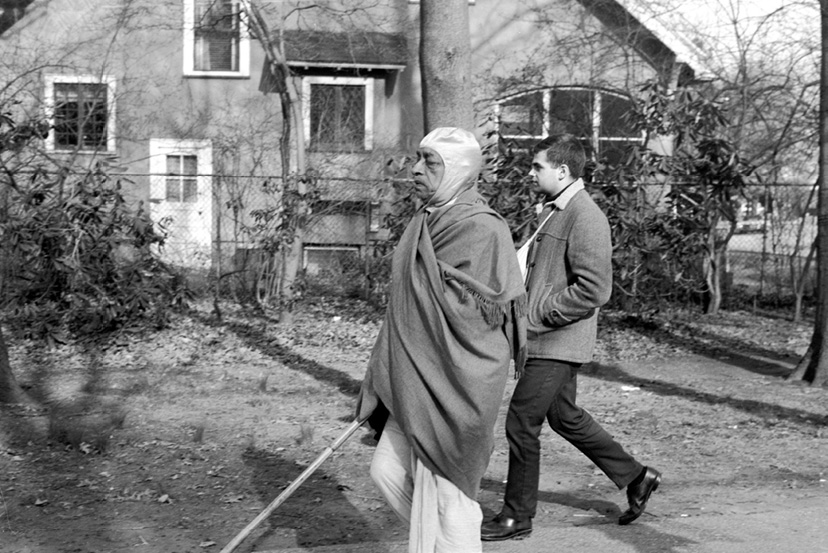
Dear Śrīla Prabhupāda,
I offer my most respectful obeisances in the dust of your lotus feet. All glories to Your Divine
Grace, a perfect instrument of your predecessors.
Śrīla Prabhupāda, it is well known in your ISKCON that you have fulfilled the preaching
desires of Caitanya Mahāprabhu and His Gauḍīya ācāryas. For example, in offering you our
respects, we blissfully say,
namas te sārasvate deve gaura-vāṇī-pracāriṇe
nirviśeṣa-śūnyavādi-pāścātya-deśa-tāriṇe
Our respectful obeisances are unto you, O spiritual master, servant of Bhaktisiddhānta
Sarasvatī Gosvāmī. You are kindly preaching the message of Lord Caitanyadeva and
delivering the Western countries, which are filled with impersonalism and voidism.
You and you alone took the message of Caitanya Mahāprabhu all over the world. Others only
tried to follow in your wake. Tried!
The full message of Lord Caitanya is clearly delineated in the Caitanya-caritāmṛta. The founda-
tion of that worldwide mission is distributing Kṛṣṇa’s holy names and the teachings of Śrīmad-
Bhāgavatam, both of which we, your followers, are fortunate to have received and framed our
lives around. And just as every activity has a purpose, a sādhya, so too does the mission of Lord
Caitanya.
In His meeting with Śrī Rāmānanda Rāya, Caitanya Mahāprabhu’s first inquiry was to hear a
verse from the revealed scriptures concerning the ultimate goal of life and the means to attain it.
Śrī Rāmānanda replied that offering one’s activities through the varṇāśrama institution would be
the best means to please Kṛṣṇa – the former the means, the latter the goal.
Caitanya Mahāprabhu, however, rejected this answer, as He did subsequent answers, until
Rāmānanda offered pure devotional service as the means to please Kṛṣṇa. Thereafter the Lord
desired to hear about the stages of pure devotion, including the ascending stages of loving devo-
tion – servitude, fraternity, parental love, and conjugality. These forms of vraja-prema enable devo-
tees to enter Kṛṣṇa’s eternal pastimes of love.
Dear Śrīla Prabhupāda, your followers will readily confirm that our destination is Goloka Vrin-
davan. However, Rāmānanda Rāya says that such Vraja perfection can only be attained through
spontaneous love. Regulative devotion is insufficient to that end. The nāyaṁ sukhāpo bhagavān
verse – which Viśvanātha Cakravartī Ṭhākura calls the paribhāṣā-sūtra of the Tenth Canto – is
further evidence of this.* Thus, while your followers begin their sādhana in a regulated way, at
a certain stage of maturity they too acquire greed for vraja-bhakti and so evolve in spontaneous
devotion.
Throughout your books and teachings, you have further elaborated upon this very same goal
and the very same forms of practice. If we return to the exchange with Rāmānanda, we find
that both sādhana and sādhya are summarily revealed in the nibhṛta-marun-mano verse cited and
explained by the Rāya:**
nibhṛta-marun-mano-’kṣa-dṛḍha-yoga-yujo hṛdi yan
munaya upāsate tad arayo ’pi yayuḥ smaraṇāt
striya uragendra-bhoga-bhuja-daṇḍa-viṣakta-dhiyo
vayam api te samāḥ sama-dṛśo ’ṅghri-saroja-sudhāḥ
Great sages conquer the mind and senses by practicing the mystic yoga system and
controlling the breath. Thus engaging in mystic yoga, they see the Supersoul within
their hearts and ultimately enter into impersonal Brahman. But even the enemies of the
Supreme Personality of Godhead attain that position simply by thinking of the Supreme
Lord. However, the damsels of Vraja, the gopīs, being attracted by the beauty of Kṛṣṇa,
simply wanted to embrace Him and His arms, which are like serpents. Thus the gopīs
ultimately tasted the nectar of the lotus feet of the Lord. Similarly, the Upaniṣads can also
taste the nectar of His lotus feet by following in the footsteps of the gopīs.*
It may be asked why Rāmānanda Rāya cited an example relating to mādhurya-rasa. The answer is
that Lord Caitanya asked about the ultimate goal of life, and that goal is found in conjugal love.
In a purport, you confirm that conjugal love is the ultimate goal for most Gauḍīya Vaiṣṇavas:
There are different types of devotees – those in śānta-rasa, dāsya-rasa, sakhya-rasa, vātsalya-
rasa, and mādhurya-rasa. Although all the rasas are on the transcendental platform,
mādhurya-rasa is the supreme transcendental mellow. Consequently it is concluded that
the worship of devotees engaged in the Lord’s service in mādhurya-rasa is the supreme
spiritual activity. Śrī Caitanya Mahāprabhu and His followers mainly worship Lord
Kṛṣṇa in mādhurya-rasa.**
Since a sādhana must correspond to its sādhya, Rāmānanda Rāya says that mature devotees should
accept the mood of the gopīs in their service and think of the pastimes of Rādhā and Kṛṣṇa. The
word sama-dṛśaḥ in the nibhṛta-marun-mano verse is the essence of this sādhana: to follow the mood
of the gopīs. Similarly, the word samāḥ defines the sādhya: to attain a body like the gopī(s) whom
one follows.
I should make clear that hearing and thinking about one’s role model gopī(s) is accompanied
by standard practices, such as chanting Hare Kṛṣṇa and reading Śrīmad-Bhāgavatam. Moreover,
devotees should undertake such sādhana only when they are qualified with greed for mādhurya-
rasa, and when they have the guidance and blessing of their spiritual master(s).
Rāmānanda Rāya concludes his dissertation, saying,
After thinking of Rādhā and Kṛṣṇa and their pastimes for a long time, and after getting
completely free from material contamination, one is transferred to the spiritual world.
There the devotee attains an opportunity to serve Rādhā and Kṛṣṇa as one of the gopīs.***
In books detailing the path to vraja-bhakti, and more specifically to mādhurya-rasa, the Lord’s
followers – notably, ācāryas in Rūpa Gosvāmī’s line – have followed the sādhana taught in the
nibhṛta-marun-mano verse.
An extensive study of the Śrutis’ prayer shows that the scriptures explain the process of
rāgānuga-bhakti as the exclusive means to attain the perfection of gopī-bhāva. Moreover, Caitanya
Mahāprabhu’s acceptance of the verse and of Rāmānanda Rāya’s subsequent explanation is, of
course, the ultimate validation of the topmost sādhya and the sādhana by which that goal is to be
attained. After hearing from his newly found associate, the Lord embraced Rāmānanda Rāya and
told him,
Now that I have actually seen your glories, what I heard about you is confirmed. As far
as the pastimes of Rādhā and Kṛṣṇa in a loving mood are concerned, you are the limit of
knowledge.*
However, neither scriptures nor the conversation between the Lord and Rāmānanda detailed the
exact goal and the means for future practicing Vaiṣṇavas, for us. Thus, just as he had empowered
Rāmānanda Rāya with the responsibility of elaborately illustrating the truths of mellows, rasa-
tattva, Caitanya Mahāprabhu empowered His immediate followers to write books that would pres-
ent His teachings in further depth.
In his Jaiva-dharma, chapter 39, Ṭhākura Bhaktivinoda clearly describes the specific duty
assigned by Lord Caitanya to His principal followers. The following is a paraphrase of the
Ṭhākura’s words.
* Caitanya-caritāmṛta, Madhya-līlā 8.239
Svarūpa Dāmodara
The Lord’s most intimate associate, His personal secretary and His second body, was Svarūpa
Dāmodara Gosvāmī. To such a qualified devotee Caitanya Mahāprabhu entrusted the responsibil-
ity of teaching the process of worship endowed with transcendental mellows, rasamayī upāsanā.
Svarūpa Dāmodara fulfilled the Lord’s order by presenting his treatise in two parts – the internal
path, antaḥ-panthā, and the external path, bahiḥ-panthā.
The exoteric path of rāga-sādhana was taught to Vakreśvara Paṇḍita, who in turn taught it to
his disciple Gopāla Guru, and he to his disciple Dhyānacandra Gosvāmī. The latter wrote a book
describing his disciplic succession’s systematic, step-by-step method of practice known as Śrī
Gaura-govindārcana-smaraṇa Paddhatiḥ. That book exists today and is followed by the students of
Vakreśvara Paṇḍita’s line.
Raghunātha Dāsa Gosvāmī
Svarūpa Dāmodara taught the internal or esoteric path to Raghunātha dāsa Gosvāmī. Caitanya
Mahāprabhu entrusted the young Vaiṣṇava to the great Gosvāmī and requested him to “Accept
Raghunātha Dāsa as your son or servant.”
Dāsa Gosvāmī thus became the personal assistant of Svarūpa Dāmodara. Indeed, the Lord
gave him the name Svarūpera-Raghu, or “the Raghu of Svarūpa Dāmodara,” which is how the
young Gosvāmī became known in Jagannātha Purī.
When Raghunātha Dāsa inquired from the Lord about a sannyāsī’s duties, Caitanya
Mahāprabhu replied, “I have appointed Svarūpa Dāmodara Gosvāmī as your instructor. Learn
from him what your duty is and how to discharge it. I do not know as much as he.”
Following Caitanya Mahāprabhu’s order, Dāsa Gosvāmī accompanied Svarūpa Dāmodara
in rendering very confidential service, described as antaraṅga-sevā – service performed in one’s
spiritual body. Svarūpa Dāmodara Gosvāmī’s spiritual identity is Lalitā-devī, and Dāsa Gosvāmī’s
is Rati-mañjarī, Lalitā’s assistant. Guided by Svarūpa Dāmodara, Raghunātha Dāsa began to
serve Rādhā and Kṛṣṇa within his mind according to the above-mentioned internal path. This
meditation was recorded in Svarūpa Dāmodara’s notes, his kaḍaca, and then expanded upon by
Raghunātha dāsa Gosvāmī in his writings.
The following books of Raghunātha dāsa Gosvāmī describe how to put into practice the prin-
ciples of bhakti taught by Rūpa Gosvāmī:
• Vilāpa-kusumāñjalī describes the activities and moods that define the practice of spontaneous
practitioners.
• Vraja-vilāsa-stava outlines how, in their meditations, practitioners should maintain friendly
relationships and dealings with gopīs and other Vraja-vāsīs.
• Viśākhānandādi-stotram teaches sādhakas how to contemplate the variegated pastimes included
within the eightfold pastimes.
• Manaḥ-śikṣā guides devotees on how to absorb their minds in Kṛṣṇa’s pastimes. It should be
the first book, along with Sva-niyama-daśakam, that an aspirant assimilates.
• Sva-niyama-daśakam defines the moods required to maintain the resolute determination
needed to follow the rules and regulations of spontaneous devotion.
It is significant that Bhaktivinoda Ṭhākura gives more emphasis to the role of Raghunātha dāsa
Gosvāmī and his books than to other ācāryas and their works. Needless to say, Raghunātha Dāsa
and his teachings play a pivotal role in every sādhaka’s spiritual life, but especially in the lives of
those on the path of spontaneous devotion. For this reason, his books should be studied atten-
tively by devotees who have diligently studied your own books, Śrīla Prabhupāda.
* Lālasāmayī Prārthanā 4
Rūpa Gosvāmī
In his pastimes, Caitanya Mahāprabhu first entrusted the principles of rasa to Rāmānanda Rāya
and requested him to elaborately illustrate the same. The Rāya disclosed these truths in his
talks with the Lord on the banks of the Godāvarī. However, Lord Caitanya more fully accom-
plished this aspect of His mission through Rūpa Gosvāmī. In their talks at Prayāga, Caitanya
Mahāprabhu instructed Śrī Rūpa for ten consecutive days. These teachings of the Lord are found
in Rūpa Gosvāmī’s books, especially in the Bhakti-rasāmṛta-sindhu and Ujjvala-nīlamaṇi.
Subsequent ācāryas like Narottama Dāsa and Your Divine Grace have also emphasized the writ-
ings and teachings of Rūpa Gosvāmī and Raghunātha dāsa Gosvāmī. For example,
rūpa-raghunātha-pade hoibe ākuti
kabe hāma bujhabo se jugala-pīriti
Only if I become attached to the instructions given by the Six Gosvāmīs, headed by
Rūpa Gosvāmī and Raghunātha dāsa Gosvāmī, will it be possible for me to understand
the conjugal love of Rādhā and Kṛṣṇa.*
Similarly, Kavirāja Gosvāmī ends every chapter of the Caitanya-caritāmṛta with a request for the
blessings of Rūpa Gosvāmī and Raghunātha dāsa Gosvāmī – certainly a telling prayer.
Sanātana Gosvāmī
Caitanya Mahāprabhu continually instructed this seniormost of the Six Gosvāmīs while they
were residing in Vārāṇasī for two months. At the conclusion of their talks, Lord Caitanya gave
Sanātana Gosvāmī the responsibility to elaborately illustrate the relationship between regulative
and spontaneous devotion, and between the manifest, prakaṭa, and unmanifest, aprakaṭa, Gokula.
The ācārya fulfilled the Lord’s order by composing the Hari-bhakti-vilāsa and Bṛhad-bhāgavatāmṛta.
Gopāla Bhaṭṭa Gosvāmī
Gopāla Bhatta Gosvāmī is credited with collating the information for the Hari-bhakti-vilāsa, which
Sanātana Gosvāmī later reorganized and completed. The ācārya also wrote Sat-kriyā-sāra-dīpikā
and Saṁskāra-dīpikā. These literary efforts fulfilled Caitanya Mahāprabhu’s request to protect and
preserve the purity of mādhurya-rasa, conjugal love, while also maintaining the standards of regu-
lated devotion.
* Navadvīpa-dhāma-māhātmya 4.52
Prabhodhānanda Sarasvatī
The uncle and spiritual master of Gopāla Bhaṭṭa, Prabhodhānanda Sarasvatī was entrusted
with the service of making known that the most elevated sādhana is cultivating spontane-
ous loving attachment for vraja-rasa. His best-known works are Vṛndāvana-mahimāmṛta and
Rādhā-rasa-śuddha-nidhi.
Raghunātha Bhaṭṭa
Although not known to have written any books, Caitanya Mahāprabhu entrusted Raghunātha
Bhaṭṭa with teaching the glories of Śrīmad-Bhāgavatam because of his attachment to reading it and
his expertise in reciting it.
Jīva Gosvāmī
The most prolific and the youngest of the Six Gosvāmīs, Śrī Jīva was guided by Caitanya
Mahāprabhu through His associates. Through Sārvabhauma Bhaṭṭācārya’s disciple, Jīva Gosvāmī
was entrusted with the responsibility of teaching the philosophical conclusions of the Gauḍīyas.
Then, in Māyāpur, Nityānanda Prabhu, and in Vrindavan, Sanātana Gosvāmī, ordered Śrī Jīva
to put into writing the philosophy of Lord Caitanya’s disciplic succession. Jīva Gosvāmī thus
described sambandha, abhidheya, and prayojana in his six Sandarbhas.
Lord Nityānanda also instructed the young sannyāsī to study Vedānta-sūtra and learn how to
defeat its impersonal commentaries. After taking Jīva on a parikramā of Navadvīpa, Nitāi told his
student,
tomā-prati ājñā ei vārāṇasī giyā
vācaspati nikaṭete vedānta paḍiyā
My order to you is this: go to Vārāṇasī and study Vedānta under Sārvabhauma’s disciple,
Madhusūdana Vācaspati.*
Sārvabhauma Bhaṭṭa
Known as the greatest scholar of his time, Sārvabhauma Bhaṭṭācārya abandoned his monis-
tic ways and became a firm follower of Caitanya Mahāprabhu. The Lord then entrusted the
Bhaṭṭācārya with the responsibility of teaching the philosophical truths, tattva, regarding the
Absolute Reality. In addition to converting many scholars, Sārvabhauma wrote poems and
prayers about Lord Caitanya, Nityānanda Prabhu, and Advaita Ācārya. Through his disciple
Madhusūdana Vācaspati, Sārvabhauma conveyed the Lord’s desires to Jīva Gosvāmī.
Nityānanda Prabhu and Advaita Ācārya
Caitanya Mahāprabhu entrusted His two confidential expansions, Nityānanda Prabhu and
Advaita Prabhu, with the responsibility of preaching the glories of chanting Hare Kṛṣṇa. Since
both great souls lived in Bengal, that place was their assigned base for preaching. Taking the
initiative, Lord Nityānanda also made known the truths about Lord Caitanya and the benefit of
chanting His name.
* The specific empowerment of the ācāryas is described in Jaiva-dharma 39.
** Caitanya-caritāmṛta, Ädi-līlā 1.4
Gauḍīya Mahāntas
Bhaktivinoda Ṭhākura concludes by revealing that the responsibility of the Gauḍīya mahāntas was
to establish faith in and illuminate the truths of the kṛṣṇa-bhakti that Caitanya Mahāprabhu had
initiated. Furthermore, Mahāprabhu entrusted some of the mahāntas with composing and propa-
gating a new form of kīrtana.* Thus ends Bhaktivinoda Ṭhākura’s explanation.
According to verses like anarpita-carīṁ cirāt, Caitanya Mahāprabhu descended from Goloka to
offer the world the most confidential sādhana by which devotees can attain the perfection of gopī-
bhāva. He personally inspired people to chant Kṛṣṇa’s names as the foundational practice that
would lead them to this most confidential goal.
To Vaiṣṇava scholars like Vyeṅkaṭa Bhaṭṭa He explained the truths of mādhurya-rasa, and to his
confidential associates named above He assigned corresponding missions. In these ways the Lord
ensured that the purpose of His descent would be fulfilled and that devotees for all time could
know and perfect the conjugal mellow:
anarpita-carīṁ cirāt karuṇayāvatīrṇaḥ kalau
samarpayitum unnatojjvala-rasāṁ sva-bhakti-śriyam
hariḥ puraṭa-sundara-dyuti-kadamba-sandīpitaḥ
sadā hṛdaya-kandare sphuratu vaḥ śacī-nandanaḥ
May the Supreme Lord who is known as the son of Śrīmatī Śacī-devī be transcendentally
situated in the innermost chambers of your heart. Resplendent with the radiance of
molten gold, He has appeared in the Age of Kali by His causeless mercy to bestow what
no incarnation has ever offered before: the most sublime and radiant mellow of devo-
tional service, the mellow of conjugal love.**
Śrīla Prabhupāda, Caitanya Mahāprabhu empowered you to spread His mission throughout the
world, a mission that you fulfilled through your Kṛṣṇa consciousness movement.
As a pure devotee, you carried the duty assigned to all the above-mentioned saints. Through
your books, Your Divine Grace revealed the literary duties Caitanya Mahāprabhu assigned to His
associates, specifically to the Six Gosvāmīs. And through your worldwide preaching and nāma-
saṇkīrtana, you fulfilled Lord Gaurāṅga’s other desires, thus becoming the glorious representative
of your predecessors.
The following anecdote is confirmation that you are the emissary of Lord Caitanya and His
associates: Once, Tamal Krishna Goswami was taken for a hernia operation to a Bombay hospital,
where Śrīla Prabhupāda later visited him. While under sedation Goswami Mahārāja had a dream,
which he recounted as follows:
Before the operation began, they gave me an anesthetic and said, “Count from ten down.”
I got to about seven and that was it. I was meditating on Rādhā-Rasabihārī in the ārati,
and then I had a very good dream.
In my dream, Śrīla Prabhupāda had been called by the previous ācāryas to make a
report on his preaching mission on this planet. The previous ācāryas asked Prabhupāda,
“What is your report?”
Prabhupāda said that he had studied the people of this planet and had found that
they had no capacity for any type of austerity. Nor were they very capable of studying,
nor were they very pious. He said the only thing that they were able to do was “somehow
take shelter at my feet.”
After the operation, they wheeled me to my assigned room. Prabhupāda was sitting
there. He said, “I came here as fast as I could. I wanted to stop the operation because I
think you should have had this operation in America. But anyway, it is done now.”
He had come all the way from Juhu in a jeep in the middle of the rush hour to try to
stop the operation. I told Prabhupāda about the dream. Śrīla Prabhupāda listened very
intently and said, “Actually, this is so.”*
Śrīla Prabhupāda, you derived the phrase “Kṛṣṇa consciousness” from the words kṛṣṇa-bhakti-rasa-
bhāvitā matiḥ, a verse by Rūpa Gosvāmī that describes the urgency to acquire greed as the basis
for spontaneous devotion. This is a verse you would often quote.
In other words, when one speaks about Kṛṣṇa consciousness, one speaks about that devotional
practice that awakens greed for the service of the residents of Vrindavan, especially for the service
of Rādhā’s maidservants. Your Divine Grace comments upon this verse, which was spoken by
Rāmānanda Rāya to Caitanya Mahāprabhu:
kṛṣṇa-bhakti-rasa-bhāvitā matiḥ
krīyatāṁ yadi kuto ’pi labhyate
tatra laulyam api mūlyam ekalaṁ
janma-koṭi-sukṛtair na labhyate
Pure devotional service in Kṛṣṇa consciousness cannot be had even by pious activity
in hundreds and thousands of lives. It can be attained only by paying one price – that
is, intense greed to obtain it. If it is available somewhere, one must purchase it without
delay.**
Purport: The previous two verses are included in the Padyāvalī (13, 14), an anthology
compiled by Śrīla Rūpa Gosvāmī. Verse 69 [the earlier verse] refers to devotional ser-
vice in faith, and verse 70 [the above verse] refers to devotional service rendered out of
intense greed. The first is devotional service rendered in accordance with the regulative
principles, and the second refers to spontaneous loving service of the Lord without
extraneous endeavor. Henceforward the basic principle underlying the talks between Śrī
Caitanya Mahāprabhu and Rāmānanda Rāya will be spontaneous loving service to the
Lord. The regulative principles according to the injunctions of the śāstras are necessary
insofar as one’s original dormant Kṛṣṇa consciousness is not spontaneously awakened.
An example of spontaneous action is the flowing of rivers into the ocean. Nothing can
stop this flow of water. Similarly, when one’s dormant Kṛṣṇa consciousness is awakened,
it spontaneously flows to the lotus feet of Kṛṣṇa without impediment. Whatever will be
spoken henceforth by Rāmānanda Rāya based on spontaneous love will be agreeable to
Śrī Caitanya Mahāprabhu, and the Lord will ask him more and more about this subject.***
Dear Śrīla Prabhupāda! Perhaps like most of your followers I was a fallen, destitute soul, blind to
the meaning of life. You came into my world and charmed my soul with your sweet words, divine
countenance, and the soothing shelter that are your lotus feet. Gradually my eyes open, and as
they do, I see that within my grasp you have placed the perspective of perfection and the path
to it. Please help me reach out and accept your gift, the gift of our ācāryas, the gift of Caitanya
Mahāprabhu.
Śrīla Prabhupāda kī jaya!
Your servant,
Śivarāma Swami
* Śrīmad-Bhāgavatam 10.9.21
** Śrīmad-Bhāgavatam 10.87.23
* Cited in Caitanya-caritāmṛta, Madhya-līlā 8.224.
** Caitanya-caritāmṛta, Madhya-līlā 11.31, purport
*** Caitanya-caritāmṛta, Madhya-līlā 8.229
* Caitanya-caritāmṛta, Madhya-līlā 8.239
* Lālasāmayī Prārthanā 4
* Navadvīpa-dhāma-māhātmya 4.52
* The specific empowerment of the ācāryas is described in Jaiva-dharma 39.
** Caitanya-caritāmṛta, Ädi-līlā 1.4
* Vānipedia, Prabhupāda Memories 11
** Padyāvalī 14
*** Caitanya-caritāmṛta, Madhya-līlā 8.71 and purport
